
When leaders are still using what they learned ten weeks later, that’s behaviour change
Ten weeks is a long time in leadership
Many keynote takeaways don't last ten days, if we're being honest. People leave the room energised, maybe even scribble a few notes, then real life kicks back in. Deadlines. Emails. That tricky conversation they've been avoiding. Their good intentions get crowded out once they’re back at their desk.
So when something does stick with an audience, really stick, it's worth paying attention.
What happened at WISE26
Back on 1 February 2026, I was in Jakarta speaking at the WISE26 conference. The audience was made up of about 170 women in international education, representing more than 75 schools across 16 countries. A big room, with sharp people who have loads of experience. This is exactly the kind of audience that doesn't have time for fluff.
I shared my From Strain to Strength keynote, focusing on the congruence gap. This is what happens when pressure creates a disconnect between how leaders feel and how they show up.
The congruence gap drives rigid and reactive behaviour, and undermines performance, engagement and trust.
We focused on how to close that gap, so leaders stay clear, consistent, and credible under pressure, improving retention, engagement, and team performance.
The room was engaged. We had great conversations afterwards. All strong signs that the keynote hit home.
Then, mid-April rolled around.
Leaders are still using the tools, ten weeks later
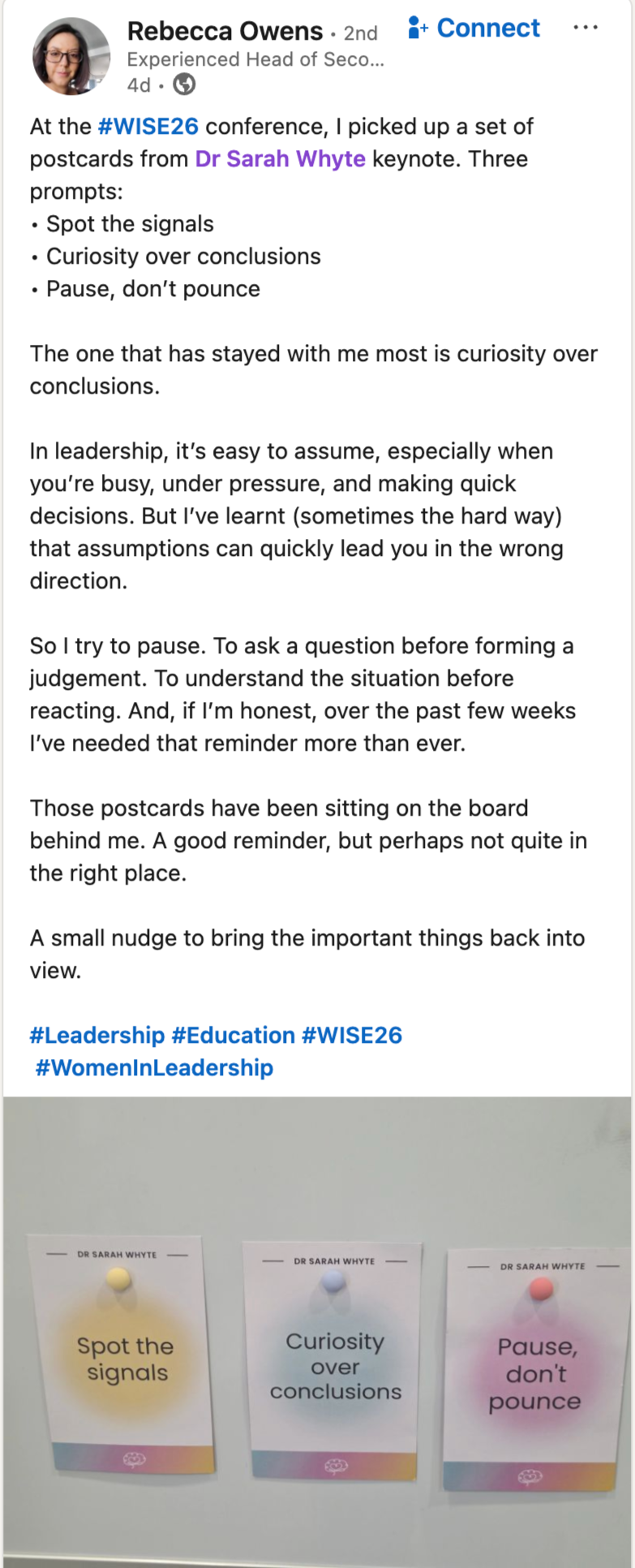
Out of nowhere, Rebecca Owens, a Head of Secondary who was in the audience, posted on LinkedIn about three small postcards she'd picked up from my keynote. Each of those postcards contains one Power Pause from my keynote.
This was something much more interesting than a keynote recap or a ‘great event’ post..
She was still using the Power Pauses.
One in particular stuck with her: ‘Curiosity over conclusions.’ She wrote about how easy it is, especially in leadership, to assume you already know what's going on. You're busy. You're under pressure. You've seen similar situations before. Your brain fills in the gaps and you act accordingly.
Except, as she so correctly pointed out, those assumptions can take you completely off track.
Now she pauses, asks a question, and aims to understand the situation better first.
That's a very different approach to drawing quick conclusions.
The responses told a bigger story
A few people chimed in underneath her post. Then a few more. The same theme kept popping up, which caught my attention.
Those postcards are still on people’s desks. They’re pinned to boards within arm's reach and in clear sight, not filed away in a drawer somewhere.
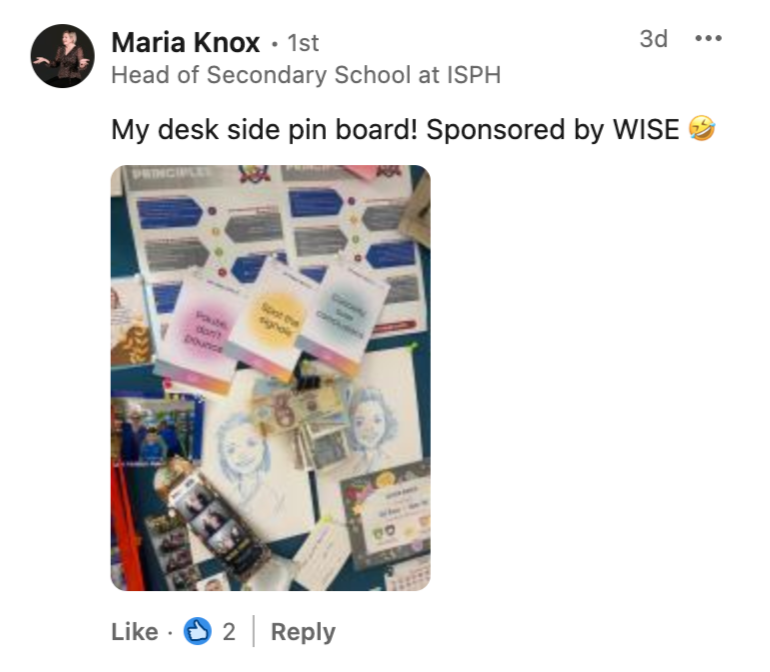
Maria Knox, a Secondary School Head, posted a photo of her desk-side pinboard with the postcards front and centre.
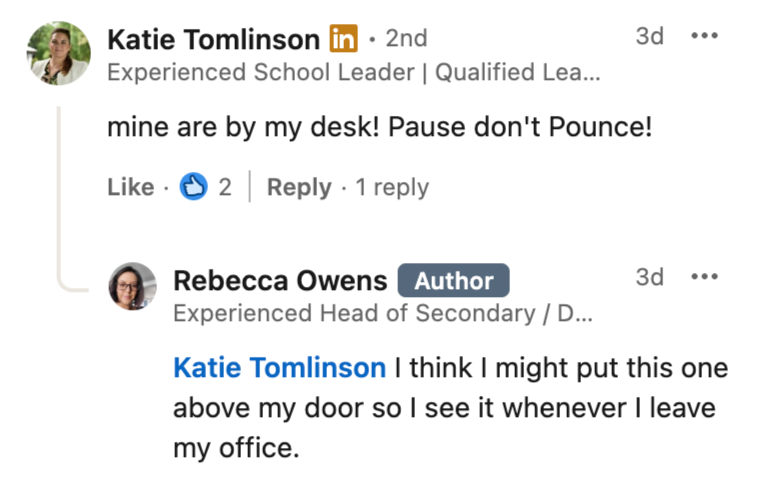
Katie Tomlinson, an experienced school leader and co-founder of the WISE conference,, shared that her postcards are by her desk too, with "Pause, don't pounce" as her go-to reminder.
Rebecca replied that she was thinking about putting "Pause, don't pounce" above her office door so she'd see it every time she walked out.
Hayley Wilson, a Deputy Head of Senior School, confirmed her postcards are pinned to her office pinboard.
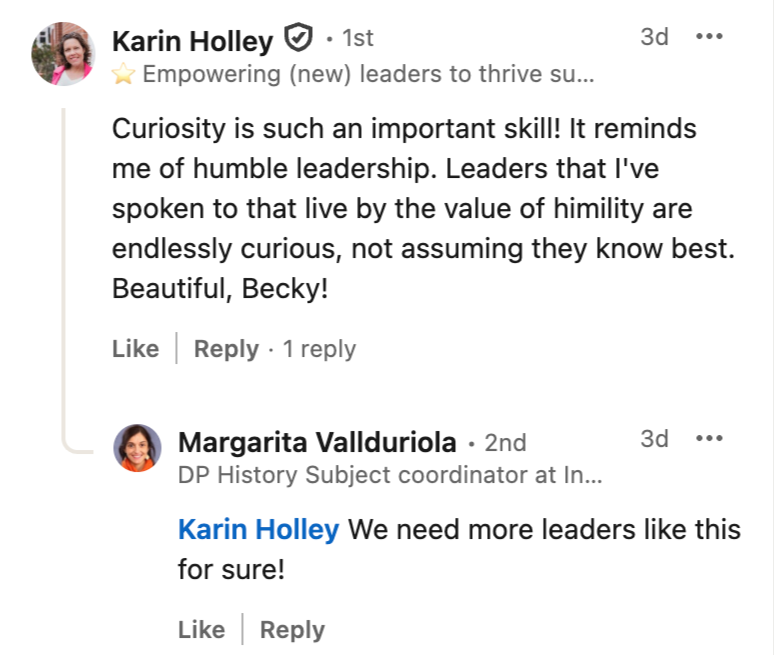
Karin Holley reflected on curiosity as an essential leadership skill, noting that the leaders she has worked with who live by the value of humility are endlessly curious, rather than assuming they know best.
For me, this goes way beyond polite feedback, like ‘lovely session, thanks.’ People in that audience actually changed something as a result of hearing my keynote.
Across different roles, different schools, and different countries, the same thing kept showing up. The Power Pauses were still visible. They’re still being used. They’re still influencing how people respond under pressure weeks later.
Why these tools stick when most keynote content fades
There's a reason for that, I think.
The Power Pauses themselves are tiny. They’re almost deceptively simple. Three Power Pause prompts:
Spot the signals.
Curiosity over conclusions.
Pause, don't pounce.
There is nothing complicated to think about, and no detailed framework to memorise. No-one needs extra time in an already-packed day to use the Power Pauses. You can use them in the middle of a tense meeting, or five minutes before a difficult conversation, or in that moment when you realise your patience is quickly running out. .
They fit into your real life at work. That's the whole point of them!
Spot the signals helps you catch your own tough emotions before they start to drive and undermine your behaviour.
Curiosity over conclusions interrupts the fast mental shortcut most of us default to under pressure. You think you know what's going on, but often you don't. Getting curious changes the whole interaction.
Pause, don't pounce creates a small gap for you to choose your response instead of defaulting to a fast reaction.
Individually, each of them is simple and powerful. When they’re used regularly, they start to change how someone leads.
The compounding return on behaviour change
Over time, those tiny moments add up. Over time, our conversations become less tense, our decision-making becomes clearer, and people around us start to speak up more. It's steady progress, which compounds over time into lasting behaviour change.
Rebecca mentioned in her post that she’s needed these reminders more in recent weeks. That line really stuck with me. Pressure doesn't disappear with experience, or show up in a predictable way. Pressure ebbs and flows. Some weeks are fine, while others are much less so.
Having practical tools you can actually use when you’re under pressure makes a difference. Each time a leader pauses before reacting, chooses curiosity over conclusions, or notices their pressure signal early, they build and strengthen a habit. Over time, that habit becomes their default. As a result, there’s an improvement in decision quality, less friction between teams, and people feel safer to speak up and do their best work.
The returns from the original keynote investment continue to grow over time.
The real value for event organisers
From an event organiser's point of view, the day of the keynote itself can be great. A full room, with strong engagement and positive feedback forms. Everyone leaves feeling good. That's important, of course.
The real question focuses on a few weeks down the line, when the slides are forgotten and the lanyards are in a drawer somewhere. Has anything changed? Are attendees doing anything differently?
If the answer is no, then the return on that investment is pretty limited. When keynote content doesn't translate into behaviour change, the real cost shows up in slower decisions, avoidable mistakes, and teams that stay stuck in reactive mode.
However, when leaders are still using a keynote tool ten weeks later, talking about it publicly, and comparing notes with each other, you're looking at something else entirely. You're looking at behaviour change, not just a good session.
That's the gap I care about closing.
This is a behaviour problem, not a content problem
If your leaders are under pressure and performance is starting to slip, the issue is rarely a lack of knowledge. Leaders in high-stakes environments are already highly capable. The problem is that pressure drives reactive behaviour: rushed decisions, assumptions, sharp-toned interactions, avoiding difficult conversations. Those micro-moments accumulate over time and undermine performance across the organisation.
Every part of my keynotes, right down to those small postcards, is designed with lasting behaviour change in mind. Of course the keynote needs to resonate in the room, but the content must also stick afterwards, so it’s used well to help with high-pressure moments when people are back at work.
Let's talk about your event
If you're planning an event and your audience includes leaders dealing with constant pressure, fast decisions, and heavy, high-stakes outcomes, it's worth thinking about what you want them to take with them from a keynote.
Energy is nice. Insight is useful. Behaviour change is where the real value sits.
If that's the outcome you're after, we should probably talk.
For HR and senior leadership teams: if you are seeing decision fatigue, reactivity, or rising errors, pressure is already affecting your results. The longer it goes unmanaged, the more it compounds. Let's address it before it shows up in your bottom line.
Dr Sarah Whyte is a keynote speaker and facilitator who works with leaders in high-stakes industries to replace reactive behaviour with intentional leadership under pressure, helping organisations protect decision quality, reduce errors and sustain performance.
